HomeScaffolding screw jacks: base jack vs U-head
Scaffolding screw jacks: base jack vs U-head
Scaffolding screw jacks are the adjustable leveling feet and U-heads that keep a scaffold plumb on uneven ground. This guide covers base jack vs U-head, solid vs hollow stems, leveling practice, and what to specify when you buy.
Published 2026-09-19 · VANHN editorial team
Scaffolding screw jacks are the threaded leveling components you fit at the bottom or top of a scaffold standard. We'll walk through what they do, the difference between a base jack and a U-head jack, solid versus hollow stems, and the specs you should put in a quote request.
What a scaffolding screw jack does
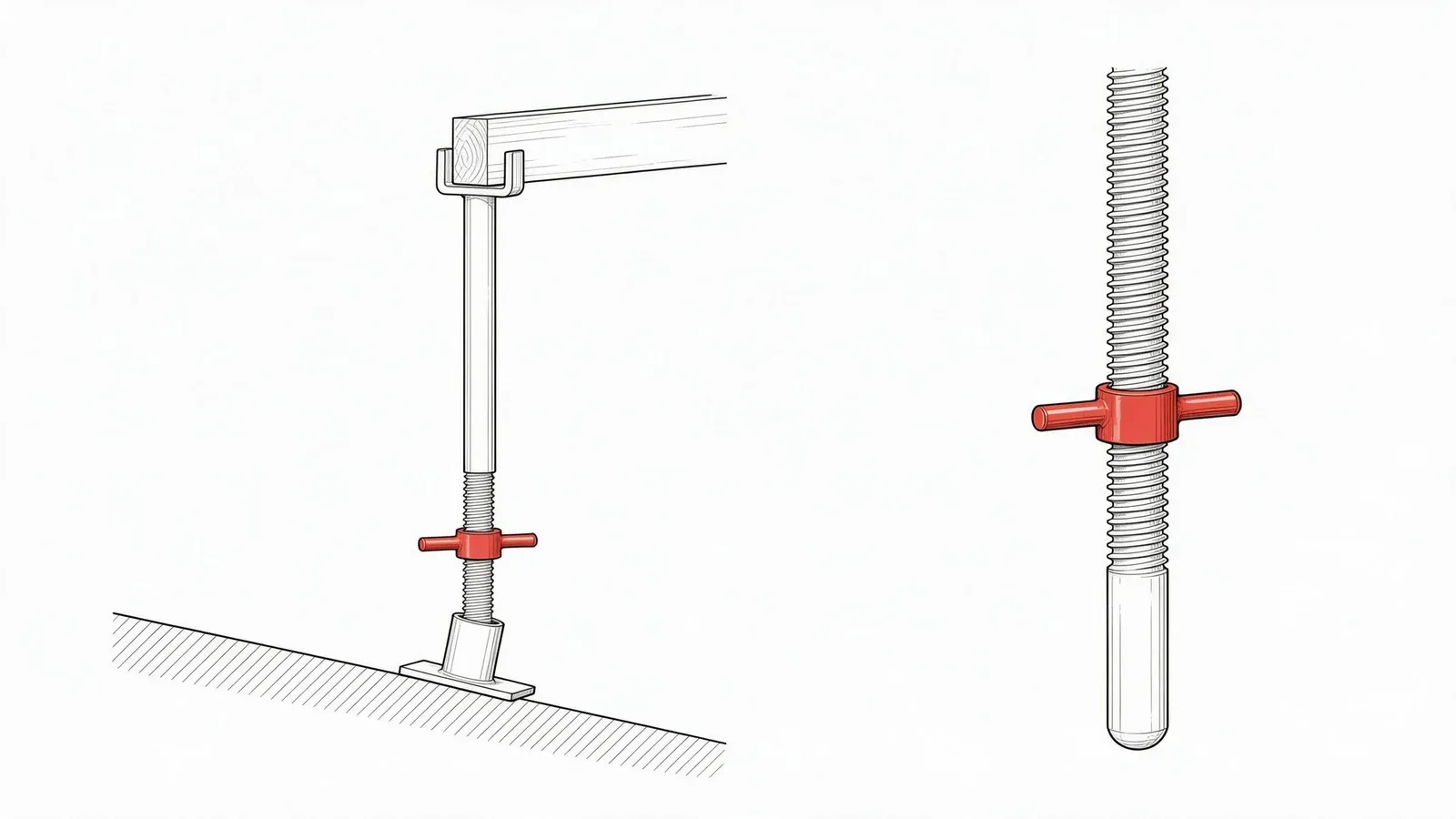
A screw jack is a threaded stem with a base plate or U-head on one end and a nut you turn to raise or lower the scaffold. A screw jack is also called a jackscrew, leveling jack, or screw leg. It's operated by turning the nut, which moves the stem up or down and gives sturdiness to the framework.
Base jacks sit at the bottom of a standard. U-head jacks sit at the top. Both do the same job: they compensate for uneven ground or slab height differences. You turn the nut until the first lift of standards is plumb and level. That matters because a level base prevents eccentric loading. Eccentric loading is when the load doesn't pass straight down through the standard. It can bend the standard or overload one side of the connection.
Adjustable screw jacks are used mainly to provide a strong base and a sturdy structure to the scaffold. They work on both even and uneven ground to level the structure. The CDC recommends using screw jacks on base plates and mudsills to keep the scaffold level. We'll get to that in the leveling section.
Base jack vs U-head jack: two ends of the same system
Think of a base jack and a U-head jack as the same threaded stem with different ends. The base jack has a square base plate welded to the bottom. The U-head jack has a U-shaped channel welded to the top. Both use the same stem diameter and nut mechanism, so a base jack and a U-head jack of the same stem size are interchangeable as far as the thread goes. The difference is where they sit and how the load is transferred.
A base jack goes under the standard. The square plate spreads the load onto the ground, mud sill, or steel plate. Base jacks are placed at the bottom of scaffolding frames to level the height and adjust for uneven ground. They're also called adjustable base plates, and that's exactly what they are.
A U-head jack goes on top of the standard. The U-shaped head holds timber or steel beams, usually for formwork or shoring. The main function of a U-Head is to hold timber beams securely in place. You'll see U-head jacks on top of shoring towers, where the beam sits in the U and the jack is adjusted to the exact soffit height.
Both types come in the same stem sizes in our range: Ø38 or Ø48 mm, 500 or 600 mm long. For heavier loads, we offer a reinforced U-head version with a thicker plate and stronger welds. It's not a different product category; it's the same U-head jack with extra stiffening.
If you're buying for a project, you'll usually need both. Base jacks for the bottom, U-head jacks for the top. Some jobs only need base jacks, like a facade scaffold on flat ground. Some only need U-head jacks, like a shoring tower sitting on a concrete slab that's already level.
Solid vs hollow stem: what the difference means
You'll see two kinds of stems on screw jacks: solid and hollow. A solid stem is machined from solid bar. It's heavier and generally used for heavier loads. A hollow stem is a tube with rolled threads. It's lighter, and it's common in system scaffolding where every kilogram counts during handling and transport.
Our stems are Ø38 or Ø48 mm, and the stem type is confirmed on the drawing. The choice depends on the system, the load requirement, and the project specification. If your engineer has specified a solid stem, don't swap it for hollow to save money. The load path is different, and the thread engagement is different. A hollow stem has less material in the thread, so it can't carry the same load as a solid stem of the same diameter. That's a general statement about materials, not a load rating. We don't publish load values here. You'll get those from your supplier's calculation or test report.
One thing to check: the nut. Our jack nuts are cast with two handles. The nut must match the stem thread. A Ø38 nut won't fit a Ø48 stem. When you specify, state the stem diameter and the nut type together.
Levelling on uneven ground
Levelling a scaffold on uneven ground starts at the bottom. Set the base jack on a mud sill or steel plate. Scaffold base plates are simple, non-adjustable feet that distribute the load to a larger area and prevent sinking. A screw jack on its own doesn't spread the load enough on soft ground. The plate or sill does that job. Then you turn the jack nut until the standard is plumb and the first lift is level.
Don't over-extend the stem. Keep enough thread engagement inside the standard. If you extend a 600 mm stem all the way out, only a few threads are inside the tube. That's a weak point. A good rule is to keep at least one-third of the stem inside the standard. We can't give you a universal number because it depends on the stem length and the tube diameter. Your project specification should state the maximum extension.
Check every jack nut is tight against the standard before loading. A loose nut allows the standard to settle or shift. After the first lift is loaded, recheck the level. The ground may compress slightly under the load, and you'll need to adjust the jacks again.
For top jacks, the same principle applies. Set the U-head jack to the required height, then tighten the nut so the beam is held securely. Don't use the U-head jack to lift a beam that's already heavily loaded. Adjust it before the load is applied.
Screw jack specifications to check before you buy
Here's what belongs on the drawing for a screw jack order. You should ask any supplier for these specs before you commit.
- Stem diameter: Ø38 or Ø48 mm. This must match the inside diameter of your standard. Check the standard's inside diameter and its tube series, 48 or 60, before you pick a stem.
- Stem length: 500 or 600 mm. Longer stems give more adjustment but reduce the load capacity when fully extended. Choose the length that covers your ground variation without over-extending.
- Base plate type: square base plate for base jacks, U-head for top jacks. Plate size is confirmed on the drawing. For U-heads, check the channel width and depth. It must fit your beam size.
- Finish: hot-dip galvanized for corrosion resistance. Painted or powder coated is an option, but for outdoor use and long service life, galvanized is the standard. If you work in a corrosive environment, ask for hot-dip galvanized.
- Compatibility: fits ringlock, cuplock, and other systems with matching tube diameter. Our jacks work with our ringlock scaffolding and cuplock scaffolding systems. If you're using another system, check the standard's inside diameter and the way the jack sits in the tube.
How to specify screw jacks in a quote request
When you request a quote from us or any manufacturer, put these items in your enquiry. It saves time and avoids a wrong quote.
- State the system and standard tube diameter. Ringlock, cuplock, frame, or other. The tube diameter tells us the stem diameter that fits.
- Specify base jack or U-head jack, and quantity of each. Don't say "screw jacks" without saying which end. A base jack and a U-head jack are different parts.
- Confirm stem diameter and length, and whether reinforced U-head is needed. If you don't know, tell us the load and the ground variation. We'll suggest a stem size.
- Ask for a drawing to confirm plate size and stem type before production. We always issue a drawing for jacks. It shows the plate dimensions, stem length, thread length, and nut type. You approve it, then we produce.
If you're not sure what you need, look at our couplers and accessories page or send us a message. We'll help you sort it out.
Base jack vs U-head jack: a quick comparison
| Feature | Base jack | U-head jack |
|---|---|---|
| Where it sits | Bottom of the standard | Top of the standard |
| End fitting | Square base plate | U-shaped head |
| Load transfer | Spreads load to ground or sill | Holds beam, transfers load from beam to standard |
| Typical use | Leveling on uneven ground | Supporting formwork or shoring beams |
| Available stem sizes | Ø38 or Ø48 mm, 500 or 600 mm | Ø38 or Ø48 mm, 500 or 600 mm |
| Reinforced version | Not standard | Available |
Buyer checklist for scaffolding screw jacks
Copy this checklist into your enquiry. It covers everything a supplier needs to quote accurately.
- System: ringlock, cuplock, frame, other
- Standard tube diameter and inside diameter
- Base jack quantity and stem diameter (Ø38 or Ø48)
- U-head jack quantity and stem diameter
- Stem length: 500 or 600 mm
- Reinforced U-head needed? Yes or no
- Finish: hot-dip galvanized, painted, or powder coated
- Drawing approval required before production
We build our own welding machines for screw jacks at our plant in Renqiu, Hebei. That means we control the thread rolling and welding quality. You can see more on our how we build page. If you want to know how we run the whole factory, start at scaffolding supplier.
FAQ
What are screw jacks used for in scaffolding?
Screw jacks are used to level scaffolding on uneven ground and to adjust the height of the scaffold. A base jack goes under the standard to level the base. A U-head jack goes on top to support beams or formwork. They compensate for ground variation and keep the scaffold plumb.
What are the regulations for scaffold screw jacks?
In the US, OSHA 1926.451 requires each scaffold component, including screw jacks, to support its own weight and at least 4 times the maximum intended load. Your supplier should provide mill documents or inspection records. Ask for them if they're not included.
How much weight can a scaffold screw jack hold?
We don't publish a load value for our screw jacks because it depends on the stem diameter, stem length, extension, and the standard it fits. Your supplier should provide a load table or test report for the exact configuration. OSHA requires the scaffold component to support at least 4 times the intended load.
What is the difference between a base jack and a U-head jack?
A base jack has a square base plate and sits at the bottom of the standard to level the scaffold on the ground. A U-head jack has a U-shaped head and sits on top of the standard to hold beams or formwork. Both use the same threaded stem and nut mechanism.
Sources
- Types and Advantages of Adjustable Screw Jacks aaitscaffold.com
- Prevent Falls: Scaffolds - CDC cdc.gov
- Base Jacks: Adj Screw Jack with Base Plate For Scaffolding Level wm-scaffold.com
- Adjustable U-Head Jack - Ascend UAE ascenduae.com
Standards and regulations are cited as public reference material on site practice. They are not claims about VANHN products.
Tell us what you are building
Say what failed you last time. We answer with specifics, not a brochure.
- Made in our own plant, 100,000 m², founded 2016
- Hot-dip galvanized, painted or powder coated
- Reply within 24 hours