HomeShoring Post Guide: From Single Props to Shoring Towers
Shoring Post Guide: From Single Props to Shoring Towers
A shoring post is the vertical adjustable steel prop that holds up formwork, slabs, and beams during construction. We'll explain how it works, when you need a tower instead, and what to ask before you buy.
Published 2026-09-19 · VANHN editorial team
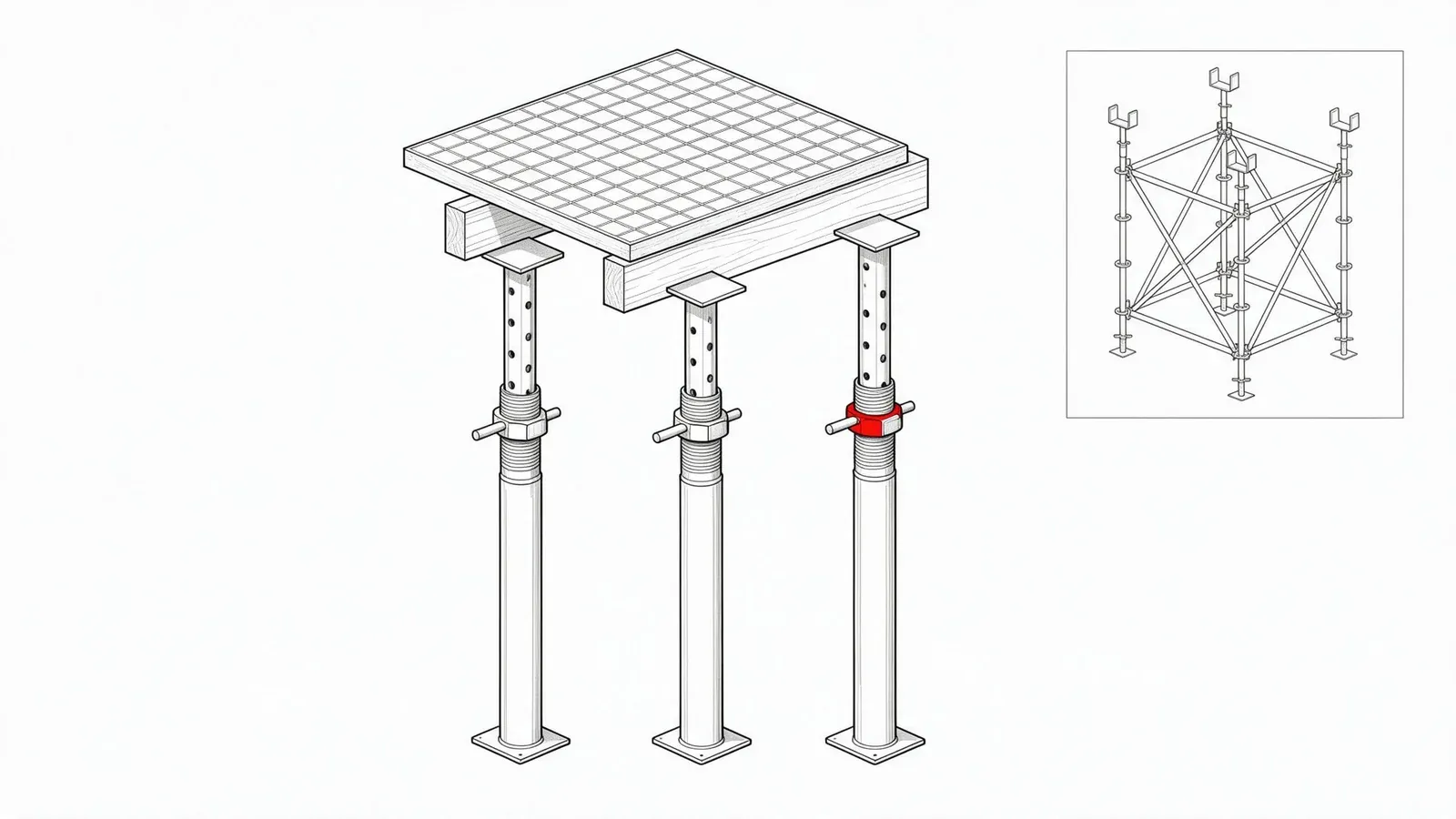
A shoring post is the vertical adjustable steel prop that holds up formwork, slabs, and beams during construction. On most jobsites, people call it a post shore or an adjustable steel prop. The core is simple: an outer tube, an inner tube, a threaded collar, and a G-pin. You set the height, drop the pin through the tube, and tighten the collar. That's it.
We build these props at our plant in Hebei. We also build the ringlock and cuplock towers that go up when a single post isn't enough. That matters because the decision between a post and a tower is the first thing a buyer should get right. Get it wrong and you either overpay for capacity you don't need or you put men under a slab that isn't supported the way the engineer drew it.
What a shoring post is (and where it fits in your shoring setup)
A shoring post is a temporary vertical support. You place it under formwork for a slab, a beam, or a wall pour, and you leave it there until the concrete can carry itself. The term gets used loosely. Some people say shoring post when they mean any adjustable steel prop. Some say post shore when they mean the same thing. A heavy duty shoring post is just a prop with a larger tube diameter or thicker wall, meant for higher loads. At VANHN, the adjustable steel prop is the product. The shoring post is the job it does.
So where does it fit? Say you're pouring a small slab, maybe a residential floor or a canopy. You set your formwork on a grid of posts, plumb them, and pour. That's single-post shoring. It works because each post carries a modest load and the slab area is small. Now imagine a parking deck or a transfer slab. The formwork is heavy, the pour is thick, and the loads are high. You don't want dozens of independent posts. You want a modular tower: ringlock or cuplock standards with ledgers and braces, all locked into one stiff frame. That's system shoring.
We make both. The adjustable steel props cover the single-post case. Our ringlock and cuplock lines cover the tower case. One factory, one supplier, both answers.
Key components and how adjustment works
Let's look at the prop itself. The outer tube is the bigger pipe, 48, 56, or 60 mm in diameter depending on the model. The inner tube slides inside it, 40 or 48 mm. At the top of the outer tube there's a threaded collar. The G-pin is a steel pin shaped like a G that you drop through a hole in the inner tube. It rests on the collar. You turn the collar to fine-tune the height.
Here's the sequence. Lift the inner tube to roughly the height you need. Drop the G-pin through the nearest hole. Then turn the threaded collar to raise or lower the pin until the prop is snug against the formwork. No bolts, no wedges. The adjustment is fast and you can do it with one hand.
Closed and extended heights are made to order. Tell us the shortest and tallest height you need on the job and we build the tube lengths to match. The base plate and U-head are separate components. A base jack has a square plate and a threaded stem. A U-head jack has a U-shaped saddle that holds a beam or formwork stringer. Stem diameters are 38 or 48 mm, with stem lengths of 500 or 600 mm. We also offer a reinforced U-head for heavy beams. Surface finish is hot-dip galvanized, painted, or powder coated. For most outdoor work, galvanized is the right call.
Load capacity: what the number means and what to ask for
Load capacity isn't a single number. It depends on tube diameter, wall thickness, steel grade, and extended height. A prop that's nearly closed can carry more than the same prop fully extended. A 60 mm outer tube with a 3.2 mm wall will carry more than a 48 mm tube with a 2.75 mm wall. And Q355 steel is stronger than Q235. All of these interact.
Specific load data is issued with the quotation. If a supplier gives you one safe working load and won't tell you the height it applies to, walk away. Ask for load tables or calculation reports for your exact closed and extended heights, your tube configuration, and your steel grade. A serious supplier will provide them. If they won't, they don't know their own product.
Single posts vs. shoring towers: a practical decision guide
So when do you use a single adjustable steel prop, and when do you move to a tower? Here's a simple framework.
Use single posts for isolated beam or column support, reshoring under a slab that's already poured, small slab areas, and heights up to about 3 meters. The prop is cheap, fast to set, and easy to move. You don't need ledgers or braces because each post stands alone.
Use a ringlock or cuplock shoring tower for large slab formwork, heavy loads, multi-level shoring, and any situation where you need a modular system with ledgers and braces. Ringlock standards are available in 0.5 to 3.0 m lengths with rosettes every 500 mm. Ledgers run from 0.3 to 3.0 m. Diagonal braces are matched to bay times lift. Cuplock standards run 0.5 to 3.0 m with cup joints every 500 mm, and ledgers from 0.6 to 2.5 m. The tower is a frame, not a collection of independent props. That stiffness matters when the concrete is wet and the loads are moving.
And here's a practical point. If you already use ringlock for access scaffolding, using the same system for shoring reduces inventory and training. Your crew already knows the rosette and wedge pin. They don't need to learn a new connection. That's a real cost saving over the life of a project.
| Factor | Single adjustable steel prop | Ringlock or cuplock shoring tower |
|---|---|---|
| Typical use | Isolated supports, reshoring, small slabs | Large slab formwork, heavy loads, multi-level |
| Height range | Up to about 3 m typical | Standards 0.5 to 3.0 m per lift, can stack |
| Load capacity | Lower, depends on tube and extension | Higher, distributed across the frame |
| Connection | Threaded collar and G-pin | Rosette and wedge pin, or cup joint |
| Stiffness | Independent posts | Braced frame, resists lateral movement |
| Inventory efficiency | Single component | Uses existing ringlock/cuplock if you have it |
Material, finish, and manufacturing quality
Steel grade matters more than most buyers think. We use Q355 for standards and Q235 for ledgers, braces, and planks. Q355 is stronger, so a standard made from it can carry more load at the same wall thickness. That lets you use a lighter standard or a smaller bay spacing. Wall thickness is 2.75, 3.0, or 3.2 mm, customizable. Hot-dip galvanized is the main finish. Painted or powder coated is available if you want a color or if the job is indoors.
How do we know the quality is consistent? Because we build the machines that make the parts. Our standards line does laser tube cutting, punching, rosette placing, automatic welding, and robot stacking. The line outputs 3,500 pieces per 10 hours. The welding machine has 13 welding power sources working at once, all MAG/CO2 gas-shielded. That's not a marketing claim. It's a description of the equipment on our floor. You can read more on our how we build page.
What to ask a supplier before ordering shoring posts
Here's the checklist we give our own buyers. Copy it and use it with any supplier.
- Tube diameter and wall thickness for outer and inner tubes. Don't accept "standard size". Get the numbers.
- Steel grade. Is it Q235 or Q355? For standards and props, Q355 is stronger.
- Surface finish. Hot-dip galvanized, painted, or powder coated? For outdoor use, galvanized.
- Closed and extended height range. Can they make custom heights? Closed and extended heights are made to order at our plant.
- Load data. Ask for load tables or calculation reports for your exact configuration. If they won't issue load data with the quotation, that's a red flag.
- Base plate and U-head details. Stem diameter, plate size, and whether a reinforced U-head is available.
- Can the supplier also provide ringlock or cuplock towers if the project grows? Sourcing both from one factory saves time and freight.
One more thing. Regulations on site require a few things from the user, not the manufacturer. A shoring drawing prepared by a qualified person shall be used on the job at all times SAIA safe practices. Erect, dismantle, or alter shoring only under the supervision of a qualified person. And a competent person has to inspect the erected shoring before, during, and after concrete placement SAIA inspection checklist. Those are your responsibilities on site. We can't do them for you, but we can make sure the components you buy are the right ones.
VANHN shoring post and shoring system specifications
Here's what we build. Adjustable steel props: outer tube 48, 56, or 60 mm; inner tube 40 or 48 mm; threaded collar with G-pin; hot-dip galvanized, painted, or powder coated. Base jack and U-head jack: stem 38 or 48 mm, length 500 or 600 mm; reinforced U-head available. Ringlock standards: 0.5 to 3.0 m, rosettes every 500 mm, tube 48.3 or 60.3 mm, Q355, hot-dip galvanized. Cuplock standards: 0.5 to 3.0 m, cup joints every 500 mm, tube 48.3 mm, galvanized or painted.
Load data is issued with the quotation. We don't put a single safe working load on a product page because it would be misleading. The right load for your job depends on your heights, your tube sizes, and your steel grade, so ask for the figures for your own configuration.
Founded in 2016, VANHN operates a 100,000 square meter site with over 400 employees and an annual output of 500,000 tons. We also build the welding equipment that makes our props and standards. That's not a side business. It's how we control the welds that hold up your slabs. If you want to see the plant, read our scaffolding supplier page. If you want to talk about a specific project, request a quote. We reply within 24 hours.
FAQ
What are shoring posts?
Shoring posts are vertical adjustable steel props used to temporarily support formwork, slabs, beams, or other structural elements during construction or repair. They consist of an outer tube, an inner tube, a threaded collar, and a G-pin for height adjustment. They are removed once the concrete or structure can support itself.
How much weight can a shoring post hold?
The load capacity of a shoring post depends on tube diameter, wall thickness, steel grade, and extended height. There's no single honest number for every prop, so load data should be issued with the quotation for your exact configuration. Ask any supplier for the figures that match your heights.
What is a shoring scaffold?
A shoring scaffold is a temporary modular structure, typically made of ringlock or cuplock components, used to support formwork and concrete loads during construction. Unlike single shoring posts, a shoring scaffold uses standards, ledgers, and braces to form a stiff frame that can handle larger slab areas and heavier loads.
What is the difference between a shoring post and an adjustable steel prop?
There is no functional difference. Shoring post is the common jobsite term for an adjustable steel prop. Both refer to a vertical support with an outer tube, inner tube, threaded collar, and G-pin. The only difference is that shoring post describes the application, while adjustable steel prop describes the product.
Sources
- Safe Practices for Erecting & Dismantling of Frame Shoring.pdf saiaonline.org
- 1926.703(b) Shoring and Reshoring - UpCodes up.codes
Standards and regulations are cited as public reference material on site practice. They are not claims about VANHN products.
Tell us what you are building
Say what failed you last time. We answer with specifics, not a brochure.
- Made in our own plant, 100,000 m², founded 2016
- Hot-dip galvanized, painted or powder coated
- Reply within 24 hours